Main content starts here.
Report on the Follow-up Event for the Kyoto International Student Summit 2025
Overview
The Kyoto International Student Summit 2025 was held for four days from August 1 to 4 to coincide with the timing of the Osaka–Kansai Expo, and a follow‑up event was organized to continue promoting international exchange after the Osaka–Kansai Expo concluded.
Date and Time
- February 19th 2026 (Thu)14:00~17:30
Format
- Online
Organizers
- Main Organizer: Kyoto Prefecture
- Management: Glocal Human Resources Development Center
Language
- English
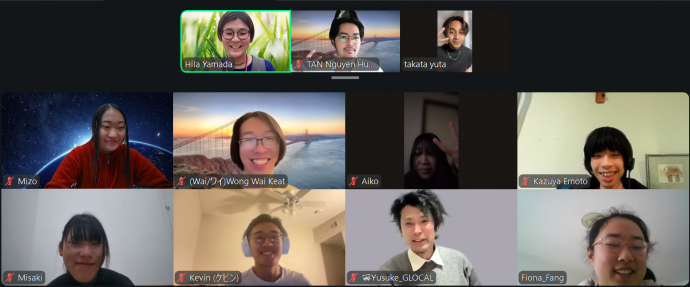
Workshop
In Session 1, participants from diverse backgrounds shared their perspectives and values, exploring approaches to the future of international exchange in their own words.
In Session 2, by working together to discuss plans for what a future Kyoto International Student Summit would look like, participants had the opportunity to reconsider new approaches to promoting international exchange from their own perspectives.
Session 1
In the context of international exchange, participants divided into groups and by using the question of “why do people from the same country tend to stick together?” as a starting point, discussed the advantages and disadvantages of mixing cultures.
Regarding “the advantages of mixing cultures,” opinions included the creation of new cultures, the generation of knowledge and networks, the broadening of one’s own perspective, and the ability to understand subtle, often unseen differences that exist between cultures. On the other hand, regarding “the disadvantages of mixing cultures,” participants shared opinions such as the avoidance of misunderstandings caused by cultural differences and the ability to preserve the uniqueness of one’s own culture.
Session 2
Building on the content discussed in Session 1, participants were divided into groups and planned and presented ideas for a future Kyoto International Student Summit.
The suggested plans included opportunities to experience Kyoto’s traditional culture, both tangible culture, such as Nishijin-ori, (a traditional woven textile from Kyoto) and the thatched-roof houses of Miyama, as well as intangible culture such as Kabuki Theatre.
Other suggestions focused on exploring towns across Kyoto Prefecture, including the Funaya boat houses in Ine and Byodoin Temple in Uji, or experiencing local food culture through activities such as fishing and cooking.
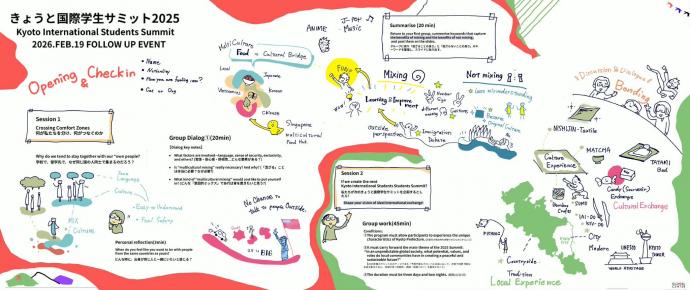
(The graphic recording created on the day)
Participants’ voices
What they learned through this event
- I realized that maintaining the attitude of expressing my viewpoints is more important than speaking English fluently. (a Japanese participant)
- I found it truly stimulating to work with participants from different cultural backgrounds to develop ideas for a future summit. In particular, the idea of using food culture as a common language was a valuable experience that allowed me to feel the potential for different cultures to come together. (an international participant)
Other
The activity report is also featured in this article.( External link )