ここから本文です。
トップページ > Foreign Language > English > All passengers are required to fasten seat belts !
Updated:September 11, 2020
All passengers are required to fasten seat belts !
The law stipulates that all passengers, including those in rear seats should fasten seat belts.
The Road Traffic Law was revised on June 1, 2008 and it is now mandatory for passengers in rear seats to fasten seat belts.
Drivers and all passengers are now required to fasten seat belts!
Seat belts are a matter of life and death
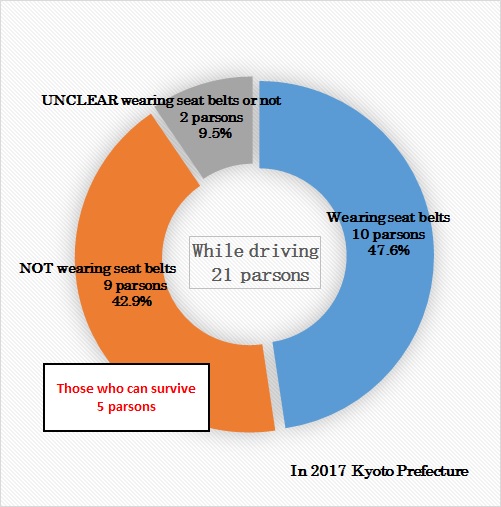
In 2017, out of 21 casualties in fatal traffic accidents in Kyoto Prefecture, 9 were not wearing seat belts. Of these 9, 5 could have survived if they had worn seat belts.
Collision test with crash dummies -Japan Automobile Federation user test-
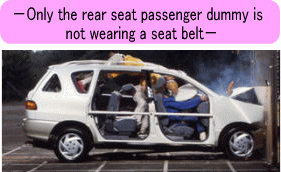
The dummy in the rear seat is thrown against the back of the driver seat, causing the dummy driver to be sandwiched between the inflated airbag and the backrest.
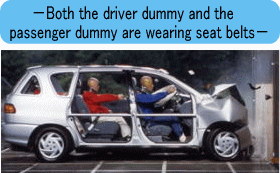
All dummies are restrained in their seated positions; they are not thrown out of their seats.
* In these experiments, the vehicles collided head-on with the wall at 50km/h.
Pregnant women are very strongly urged to fasten their seat belts!
Properly wearing seat belts can save both mothers and their expected babies.
- Properly wear both the waist and shoulder belts !
- The shoulder belt should be passed through the center of the chest to the opposite side of the abdomen !
- Adjust the shoulder belt so that it does not pass across the neck !
- Secure the waist belt across the hips and not across the stomach!
*You are not required to fasten seat belts if really unavoidable, e.g., in the case of illness or injury. Consult your doctor.
Use of child seats can save your child
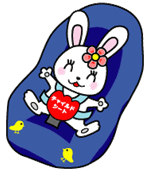
A child aged 5 or less is required to be seated in a child seat. Protect your children from traffic accidents by using child seats properly.
It is important to choose a child seat that
- fits the child's size
- features high standard of security
- can be fitted securely to the seat.
Types of child seats
For infants and small children
- Weight:9-18 kg
- Height:110 cm or less
- Age:around 1-4 years
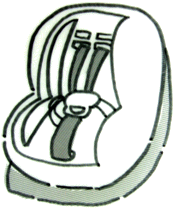
For infants, small children and school children
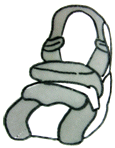
Child seats consist of a cushion, backrest, and impact shield.(For use by school children, the impact shield can be removed.)
For school children
- Weight:15-36 kg
- Height:135 cm or less
- Age:around 4-10 years
Child seat with backrest
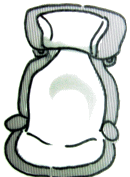
Child seat with cushion
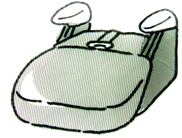
Children should use a suitable child seat until they are old enough to wear seat belts.
If a child is less than 135 cm in height (around 10 years old), a seat belt could be positioned around the neck, resulting in an accident. In this case, a child seat is recommended.
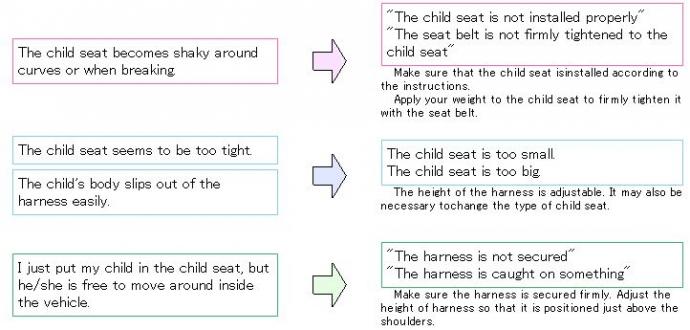
If child seats are not used properly, they will not protect children in traffic accidents!
お問い合わせ
(For Inquiries)
Kyoto Prefectural Police Headquarters Traffic Planning Division
85-3 Yabunouchi-cho, Shimochoja-machi-dori, Shinmachi-nishi-iru, Kamigyo-ward, Kyoto city
Telephone:075-451-9111